

Introduction
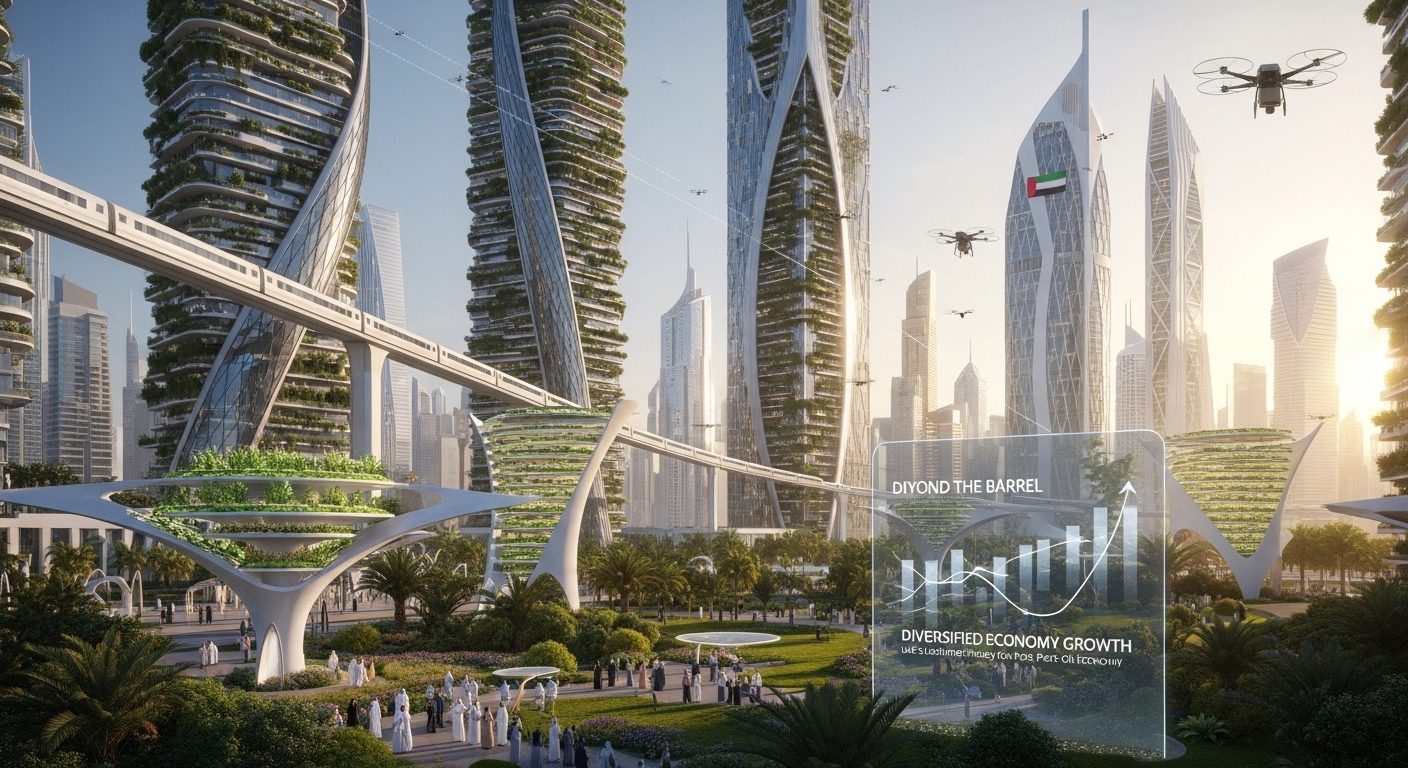
For a nation whose modern identity was forged in the fires of an oil boom, the most ambitious and defining project of the 21st century is the deliberate and strategic transition to a future beyond it. The UAE’s leadership has long understood that oil, while foundational, is a finite resource in a world increasingly focused on sustainability. This foresight has sparked a comprehensive, multi-decade strategy to future-proof the nation, ensuring its continued prosperity and relevance in a post-hydrocarbon era. “Beyond the Barrel” is not a slogan but a national imperative, driving investments in knowledge, innovation, and sustainability to build an economy resilient enough to thrive when the oil wells eventually run dry.
History
The seeds of this strategy were sown by the UAE’s founders. Sheikh Zayed himself spoke of the need to use oil wealth to build a sustainable future for generations to come. The first major step was the establishment of Sovereign Wealth Funds in the 1970s. The 1990s and early 2000s saw the bold, concrete bets on diversification: the launch of Emirates Airline as a global aviation connector, the establishment of Dubai Internet City and Media City to attract tech talent, and the visionary real estate projects that put Dubai on the global map. These were clear signals that the UAE was serious about building new economic pillars. The 2006 launch of the Masdar Initiative in Abu Dhabi, focused on renewable energy, and the 2014 announcement of the UAE Vision 2021, formally codified the shift towards a “competitive knowledge economy.”
Key Features
The UAE’s post-oil strategy is built on several interconnected pillars:
- Economic Diversification: This remains the core objective. The strategy focuses on growing non-oil sectors such as tourism (from luxury to cultural), trade and logistics, aviation, financial services, technology, and advanced manufacturing. The goal is to make the non-oil sector the dominant contributor to GDP.
- Investment in Human Capital: Recognizing that people are the ultimate resource, the UAE has overhauled its education system to foster critical thinking, STEM skills, and innovation. It has also become a magnet for global talent, creating a competitive environment where the best minds can come to live and work.
- Embracing the Fourth Industrial Revolution: The UAE is aggressively positioning itself at the forefront of future technologies. This includes a National Strategy for Artificial Intelligence, a focus on blockchain, investments in space exploration (the UAE Mars Mission “Hope Probe”), and building a robust digital infrastructure.
- Sustainability and Renewable Energy: The UAE is investing billions in solar and nuclear power (the Barakah Nuclear Energy Plant) to meet its own energy needs sustainably and to position itself as a global exporter and knowledge hub for clean energy technologies.
Cultural Significance
This strategic pivot requires a profound cultural shift from a rentier mentality to an entrepreneurial and innovative mindset. The government is actively fostering a culture of risk-taking, research and development, and private enterprise among its citizens. Initiatives like the Mohammed bin Rashid Innovation Fund and the Hub71 startup ecosystem in Abu Dhabi are designed to incentivize this change. The “post-oil” vision has become a unifying national narrative, a shared project that engages the youth and aligns with a forward-looking Emirati identity that is both proud of its heritage and confident in its ability to shape the future.
Modern Relevance
The urgency of this transition has only intensified with the global acceleration towards decarbonization. The UAE’s strategy is no longer just about economic prudence; it is about geopolitical and economic survival in a changing world. Its hosting of COP28 in 2023 was a strategic masterstroke, allowing it to lead the global conversation on a pragmatic, inclusive energy transition. The UAE argues for a “energy mix” approach, where oil and gas play a role during the transition while renewables are scaled up, a position that protects its immediate interests while committing to a sustainable long-term future. The success of this strategy is already visible, with Dubai’s GDP, for example, being over 95% non-oil.
Conclusion
The UAE’s journey beyond the barrel is the ultimate test of its visionary model. It is a deliberate, complex, and unprecedented endeavor to orchestrate a managed decline of one economy while simultaneously birthing another. This is not a passive response to a distant threat but an active, aggressive, and optimistic construction of a new reality. By leveraging the financial capital and infrastructure built during the oil era to invest in human capital, technology, and sustainability, the UAE is striving to write a new chapter in its remarkable story—one where its prosperity is generated not by the resources beneath its feet, but by the ingenuity and ambition of its people and its institutions.